

4 Yoga Mistakes that Can Cause Knee Pain

Sadie Nardini by Sadie Nardini | July 15th, 2009 | Comments (15)
topic: Fitness, Health & Wellness, Healthy Aging, Yoga | tags: alignment, core, flexibility, flexors, hamstrings, hips, IT band, joints, knees, nardini, pain, quadriceps, release, sadie, strength, vinyasa, Yoga

Senior Woman Warrior

Yes, yoga is known for its healing powers and ability to transform your body and mind into a lean — yet much less mean — you.

However, it’s also a physical exercise and often a vigorous one. As such, if done incorrectly, it can also cause pain and even major injury. One MD friend told me recently he’s never seen this many muscular and joint issues stemming from yoga. And by “issues,” he means ruptures, pulls, tears and herniated discs. All of which could, and do, halt yoga practitioners in their tracks every day.

Now, I’m not trying to cast a dark cloud over your practice. I want to give you the power to protect your precious knees by handing you the knowledge it takes to be mindful to your potential trouble spots when you’re on the mat. I want most of all to see you keep your body healthy and help your yoga experience remain empowering — and last a lifetime.

This week, we’ll focus on the knees. For a more in-depth study about how your body works within the poses, I recommend the fabulous Yoga Anatomy by Leslie Kaminoff.

For our purposes today, I’ve simplified the complex structure of the knee into instructions you can use the very next time you practice, knowing that you are moving away from potential injury and toward balance with each session.

We’ll focus on common yoga mistakes that can cause knee pain and how to avoid them. The below four poses exemplify how the knees can be taken out of alignment during yoga, and since the principles of alignment apply to your whole practice, you can use the information to keep an eye on all your other poses, too.

An added bonus is that when you free your knees, you’ll gain more strength and stability, and your body will release into flexibility more fully. So when your knees win, so do you!

Enjoy,

Sadie

4 poses to move from knee strain … to gain!

Please warm up first with three to five Core Sun Salutations, and remember to breathe slowly and deeply through your nose for the entirety of the practice.

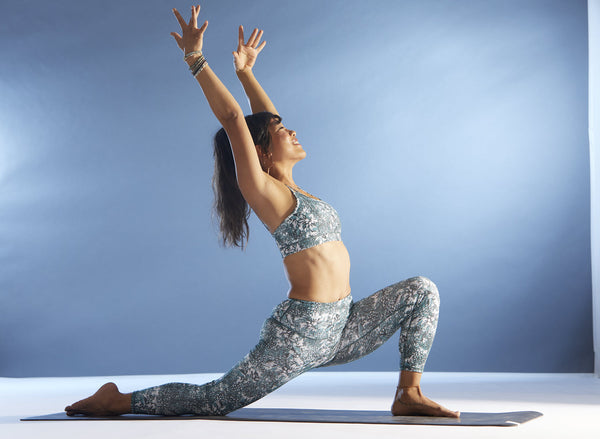
1. High Lunge

dsc_0082

When you’re in Down Dog, as you step one foot forward toward a lunge preparation, you want to hit two points of alignment right away:

  • Your foot should step to the same thumb (right foot to right thumb), not to center between your hands.
  • When you come up, this will bring your knee wider, pointing directly forward from your hip joint rather than buckling the knee in toward center, moving it off of the hip line. You’ll bring the weight on your knee joint into balance.
  • Your toes and fingertips should be in the same line, so your foot is all the way up, not lagging back behind your hands.

When you come up, this will ensure that with a bent front leg, your knee will hover over your heel or back toward your body more, but not jut out over your foot, causing pressure over the front of your knee.

Applies to: Any standing pose where you step forward with a bent front knee such as Warrior I and II, Side Angle, Reverse Warrior, Chair Pose, Eagle Pose

2. Warrior I

dsc_0204

Bring your awareness to your back leg in this pose. One rule of knee health to observe: Your toes, knee and center of the hip should all be facing the same angle.

This means that if your back toes are facing diagonally out in a 45-degree angle, then your knee should also be turned to face the same direction as the toes — to 45. The problem arises from a commonly taught but incorrect instruction that can wreak havoc on the knee joint: “Square your hips forward in Warrior I.” I hear this in many a yoga class — and it’s anatomically misaligned.

With your back foot anchored at 45 degrees, if you try and turn your hips farther forward than 45 degrees, it’s your knee joint that will take the twist. Now, sometimes yoga twists are good, but in this case, the knee is not meant to twist and doing so can cause chronic tweaks or serious damage.

So, when in your Warrior I, allow your back hip to roll open just enough to bring the center of your thigh and hip into the same angle as the toes and knees. In Warrior I with your right foot forward, for example, your hips should face diagonally to the right, not totally open like a Warrior II or fully squared forward like a Lunge (whose lifted back heel makes the forward hip alignment knee-safe).

From your diagonal hips, spin your top body forward, not from the pelvis but from the ribs, heart, shoulders and head. You’ll feel more muscles activate in your core and back while maintaining space and freedom in your knee and hip.

Applies to: Any anchored-foot standing pose like Warrior I, II, Side Angle, Triangle, Reverse Triangle (really watch the knee in these revolved poses!), Parsvottanasana, Malasana

3. Triangle Pose

dsc_0557

In these straight-legged poses, pay attention to your front knee. It’s easy to:

1) Lock the knee and hang out in the joint instead of activating your leg muscles for support.

2) Press too hard back into the joint, which can cause hyperextension or overstretching at the back of your knee.

Instead, let there be a microbend in your front knee, so you’re not jamming back into the joint and slacking the muscles. Then firm your muscles around the thigh and knee and press out through your foot as if you’re stepping on an accelerator.

Which, when you think about all the benefits you’re getting by moving out of the joint and into your strength…you are.

Applies to: Any straight front leg pose that bears weight, like Parsvottanasana, Warrior III, ½ Moon, Tree Pose, Standing Splits

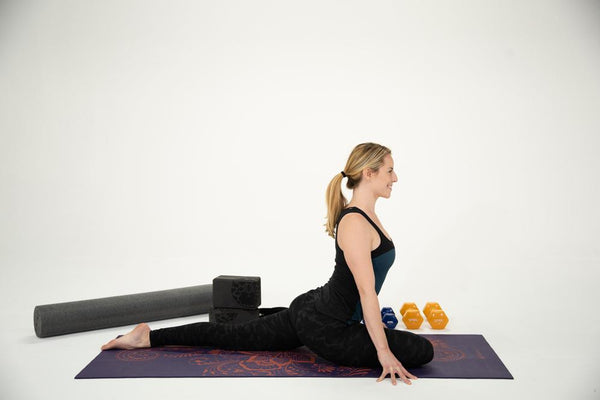
4. Pigeon Pose

dsc_00641

This pose asks you to externally rotate or turn out your front leg, which puts a good amount of pressure on the knee, especially if you have tight quadriceps (front thighs), adductors (inner thighs) or hip rotators (outer hips).

When you fold forward, the tilt of your pelvis causes even more stretch around the knee. If misaligned, the shear pressure on your knee joint can be too much.

When you come into Pigeon, three common mistakes and their solutions are:

1) Flexing your foot

A flexed foot can cause the lower leg to cease its external rotation, again, causing the knee joint to take the twist as you bend forward. Instead, “froint” the foot — point the foot but draw the toes back and press out through the ball of the foot, as if you’re wearing high heels (yes, guys…even you).

This will allow the whole leg to more freely rotate, releasing the knee.

2) Grabbing the foot and pulling it forward to take the shin more parallel to the front of the mat

Just because the shin is forward doesn’t make the pose more advanced. In fact, yanking the foot forward or hooking the flexed foot around the wrist, knee to other wrist, means you’re working to get your shin forward into a certain look of the pose, but you might be seriously compromising your knee joint.

From this moment on, never grab your foot with your hand in this pose. Instead, back your foot off toward the opposite hip crease and make sure your hips are level (not rocking over to rest on the bent leg’s hip).

Then, to deepen the pose if this feels fine on the knee, you can move your knee slightly wider and scoot your back leg straight back a little more. The front knee should be either in front of your hip or a bit wider, and you can repeat that adjustment (knee wider, back leg back) a couple of times. But don’t wait till you feel a huge stretch to fold forward, remembering that tilting the pelvis into a fold increases the knee strain. So save some room to move for your forward bend.

In this way, your shin and frointed foot will come forward naturally and totally hands-free.

3) Working with the hips too low if the knee hurts

For some, bending the front knee in Pigeon and having the hips lowering can pull the quadriceps and front of the knee, straining the knee joint before it stretches the hips. If you feel knee pain before a hip stretch, work on tighter front thigh muscles first by raising your front hip onto a rolled blanket or block(s).

Allowing your quads to release by lowering your bolster little by little over time will eventually get you into the hip muscles without overwhelming your knees.

Applies to: Any externally rotating leg poses, like Ankle to Knee, Gomukhasana, ½ or Full Lotus (I don’t recommend the Lotus poses due to their extreme knee torque), Flying Crow, Supine Pigeon, Janu Sirsasana

Share and Enjoy:
  • Digg
  • del.icio.us
  • Facebook
  • LinkedIn
  • MySpace
  • Reddit
  • StumbleUpon

Comments

  1. Thank you I found this article to be extremely helpful ,not only for my personal practice, but as a teacher to bring this information to my students.

    I followed your suggestions, and immediately, felt the difference.
    I’ll be sharing this knowledge in my class tomorrow.

    Namaste,
    Clay Goldstein

    clay goldstein | July 15th, 2009 | Comment Permalink
  2. Great, Clay–glad I could be of service to you, your students, and all your knees;)

    Namaste,
    Sadie

    Sadie Nardini | July 15th, 2009 | Comment Permalink
  3. Thanks for the tips. I had knee surgery about a year ago for a torn ACL. Pigeon is my favourite pose and still bothers it sometimes. I am going to try the “froint” this evening!

    Charlotte | July 15th, 2009 | Comment Permalink
  4. thanks for this article! three out of four of these bother me, and i really appreciate the tips! terrific!!

    Nancy | July 15th, 2009 | Comment Permalink
  5. Hey Nancy–
    Which ones bother you, and where? I can give you some modifications that will help!

    Sadie

    Sadie Nardini | July 15th, 2009 | Comment Permalink
  6. Gaiam also has my Strong Knees DVD to help people with knee pain.

    Chantal Donnelly | July 17th, 2009 | Comment Permalink
  7. : “Square your hips forward in Warrior I.” I hear this in many a yoga class — and it’s anatomically misaligned.
    Sadie thank you for pointing this out…I was new to yoga and the instructor kept saying this and I also read the same advise on Yoga websites. But it never felt right to me and I have always resisted warrior 1 because of this.
    I would think squaring your hips with your leg in that position would actually torque the knee if your hips are not flexible?

    Kat | July 18th, 2009 | Comment Permalink
  8. Hi Kat–

    Exactly. It can torque the knee even IF your hips are flexible. People think the leg can turn out healthfully from the hip, which, if the foot isn’t anchored, it can. But in a standing pose like Warrior 1, when the foot is grounded, turning the hip forward against that is not healthy for the knee joint.

    I hope this frees you to re-discover the pose, which is so empowering when it’s properly aligned.

    Namaste!
    Sadie

    Sadie Nardini | July 19th, 2009 | Comment Permalink
  9. This is great, thank you. Would you consider following this up with some similar feed back on poses that stress the hips? My knees are shipshape, but after major hip surgery as a child I find some supposedly simple poses (Warrior 1) to be incredibly challenging, yet others are so refreshing. (Pigeon, Cow Face) Any thoughts? :)

    Marie | July 24th, 2009 | Comment Permalink
  10. I will do that–I have some great suggestions for you.

    Namaste!
    Sadie

    Sadie Nardini | July 24th, 2009 | Comment Permalink
  11. Great advice …… I have been making these mistakes and have been suffering from knee pain ……. thanks so much ….

    Ginny | July 28th, 2009 | Comment Permalink
  12. Hi Sadie

    Just wanted to share with you that I have used your advice in my classes, and my students are extremely grateful. They noticed the difference immediately when doing Warrior 1. Thank you again
    I also would appreciate any advice you can give on hip openers and balance asanas.

    Namaste,
    Clay

    clay goldstein | August 1st, 2009 | Comment Permalink
  13. “froint” the foot? I have been taught by Anusara teachers to “floint” (flex + point).
    Is there a difference between the two, or just a typo?

    devilee | August 16th, 2009 | Comment Permalink
  14. These are some great teaching tools that I am going to use in my yoga classes this week! It makes such perfect sense! I have been trying to torque my body to fit this Warrior I pose for years. Love this! I’m going to start re-learning and re-teaching this pose immediately. Love the Froint, or Floint term too. Thanks Sadie!
    :)
    Jill

    Jill Slater | September 6th, 2009 | Comment Permalink
  15. Thank you for this article! Finally some answers! I’ve been having knee pain from these exact poses but my instructors were unable to give me detailed ways to fix the problem. Thank you again!

    Maria | November 16th, 2009 | Comment Permalink

Post a Comment

If you want to show your picture with your comment, go get a gravatar!